
Why One-Off Technical Training No Longer Works for Modern IT Teams
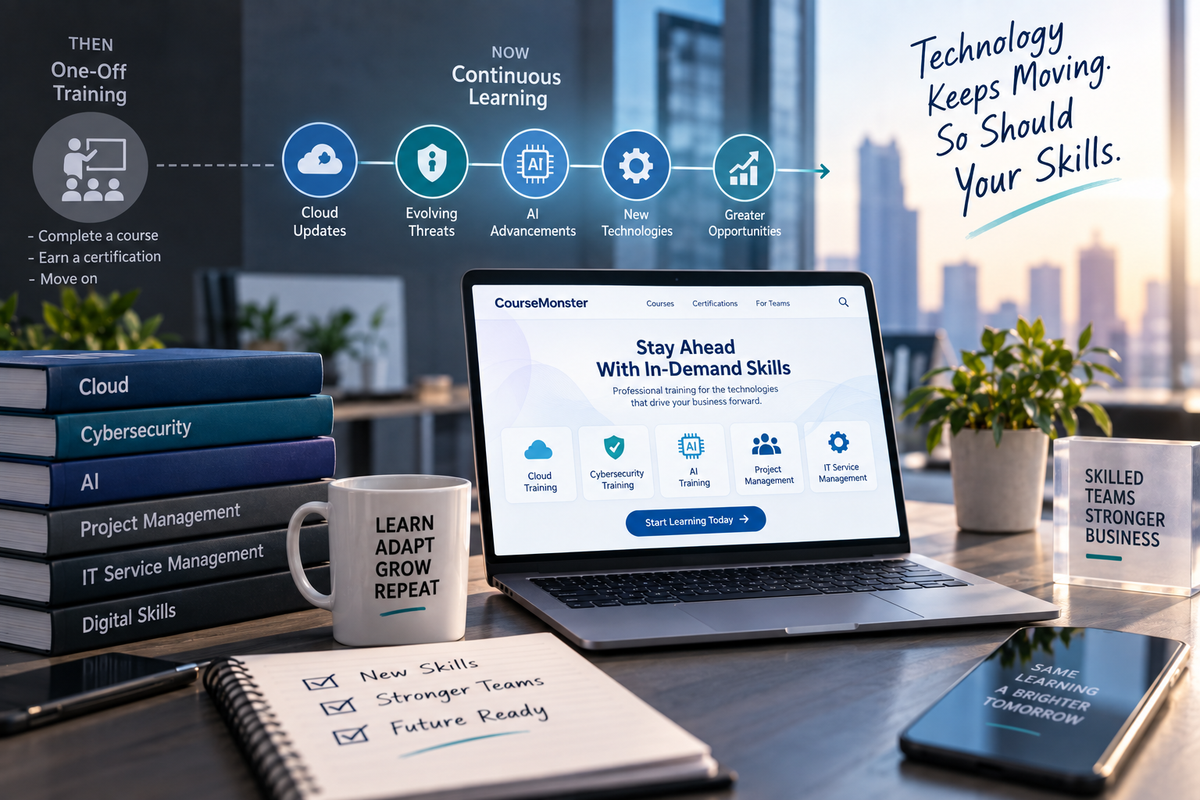
For years, many organisations treated technical training as an occasional event. A new platform was introduced, employees completed a course, certifications were earned, and training was considered finished until the next major change appeared.
That model made sense when technology moved more slowly.
Today, it is much harder to justify.
Cloud platforms release new features constantly. Cybersecurity threats evolve every week. AI tools are changing the way employees research, communicate, analyse data, and automate work. Software platforms are updated continuously, and compliance requirements can shift as organisations adopt new technologies.
In this environment, technical capability cannot be maintained through one training programme every few years. Learning needs to become an ongoing part of how IT teams operate.
Skills Can Become Outdated Faster Than Expected
A certification or course provides valuable knowledge at a particular point in time. However, the technology behind that training may continue to change.
A cloud engineer who completed training two years ago may now be working with services, security controls, or automation features that were not covered in the original course. A cybersecurity professional may face new attack methods that were not common when they last completed formal training. An employee trained on generative AI only a year ago may already be working in an entirely different tool environment.
This does not make the original training useless. It simply means that technical knowledge has a shelf life.
Organisations need a way to refresh and expand that knowledge before skill gaps become operational problems.
Technology Projects Do Not Wait for the Next Training Cycle
Businesses rarely introduce technology according to a convenient annual learning calendar.
A new cloud project may appear because the organisation needs more scalability. A security programme may become urgent after an audit identifies a weakness. A department may suddenly want to experiment with AI because competitors are already using it.
When these changes happen, organisations need employees who are prepared to respond.
If training only happens once or twice a year, teams may be forced to learn under pressure while a project is already moving forward.
Continuous learning gives organisations a stronger foundation. Employees are more likely to already understand the technologies and concepts involved, reducing the amount of catching up required when priorities change.
Small Knowledge Gaps Can Grow Into Bigger Problems
Technical skills rarely disappear overnight.
The decline is usually gradual.
An engineer may become less familiar with a platform update. A security specialist may not fully understand a new control. A project manager may continue using an older process because they have not been exposed to newer methods.
Individually, these gaps may appear minor.
Across a department, however, they can create inconsistent practices, slower troubleshooting, increased dependence on a small number of experts, and greater risk during implementation.
Ongoing training helps organisations address these gaps while they are still manageable.
Continuous Learning Does Not Mean Constant Courses
One concern organisations may have is that continuous learning sounds like employees will spend their entire working week in training.
That is not the goal.
A continuous learning strategy can include short courses, certification updates, technical workshops, practical labs, team learning sessions, and focused training connected to upcoming projects.
The important point is consistency.
Instead of waiting until a major skills shortage appears, organisations can regularly strengthen the capabilities that matter most.
This approach can also make learning easier for employees because development happens in manageable stages rather than through large training programmes introduced all at once.
Align Learning With the Technology Roadmap
One of the most effective ways to manage ongoing training is to connect it with the organisation's technology roadmap.
If a business plans to expand its cloud environment during the next six months, the relevant teams can begin developing those skills now.
If AI adoption is planned across several departments, employees can start with foundation-level training before moving into role-specific applications.
If an organisation expects new cybersecurity or compliance requirements, learning can begin before those requirements become urgent.
This makes training proactive rather than reactive.
Employees develop the skills before the business becomes dependent on them.
Different Roles Need Different Learning Paths
Continuous learning also works best when organisations avoid sending everyone through exactly the same programme.
An infrastructure engineer may need advanced cloud and networking skills. A security professional may need deeper knowledge of threat management and governance. A project manager may need enough technical understanding to coordinate delivery without becoming an engineer.
Executives may need a strategic understanding of AI or cybersecurity risks rather than detailed technical instruction.
Creating learning paths around roles allows organisations to keep skills current without overwhelming employees with information they are unlikely to use.
Encourage Knowledge Sharing Inside the Team
Not every new skill needs to come from a formal course.
Internal knowledge sharing can play an important role in continuous development.
When one employee learns a new feature, solves a difficult technical problem, or completes an advanced certification, that knowledge can be shared with the wider team.
Short review sessions, internal demonstrations, documentation, and peer discussions can help spread knowledge much further than the original learner.
This also reduces the risk of creating single points of failure where only one employee understands a critical technology.
Review Skills Regularly
Continuous learning becomes much more effective when organisations regularly review the skills they already have.
This could happen quarterly, twice a year, or alongside technology planning.
Managers can look at upcoming projects, changing platforms, employee responsibilities, and areas where external support is being used heavily.
From there, they can identify where capability needs to be strengthened.
A regular review also prevents organisations from continuing to invest in training simply because it was useful in the past.
Training priorities should evolve as the organisation evolves.
Measure Whether Learning Is Reaching the Workplace
Continuous training should still produce measurable results.
Organisations can look beyond course completion and ask whether employees are using the new knowledge.
Are projects being delivered more confidently?
Are teams solving technical problems faster?
Is dependence on external consultants decreasing?
Are more employees able to support important systems?
Are security and operational practices becoming more consistent?
These outcomes provide a better indication of whether continuous learning is creating genuine value.
Build Learning Into the Way IT Teams Work
Technology is unlikely to slow down.
The organisations that adapt successfully will be those that treat technical capability as something that must be maintained continuously rather than refreshed occasionally.
Explore CourseMonster Training Subscriptions.
A structured approach to ongoing learning can help organisations keep critical skills current, prepare employees for future projects, and reduce the disruption that happens when new technology arrives faster than the workforce can adapt.
Training should not only prepare employees for the technology they use today.
It should help them stay ready for what comes next.
Visit Coursemonster: www.coursemonster.com
Comments ()