
Train Before You Transform: Why Upskilling Should Come Before Major Technology Rollouts
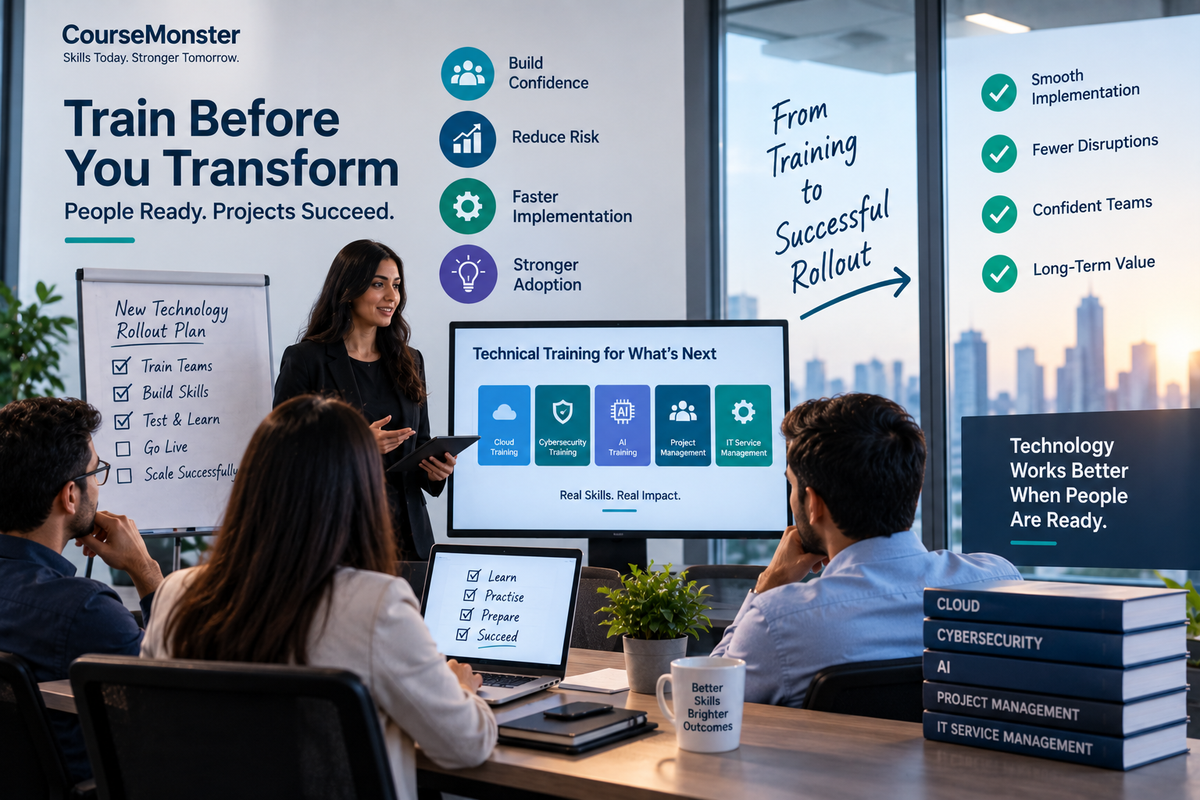
When organisations invest in new technology, most of the attention naturally goes to the platform itself. Leaders compare vendors, approve budgets, plan integrations, define timelines, and prepare implementation teams. Training is often included somewhere in the project plan, but it is frequently treated as something that can happen later.
That can be a costly mistake.
A new cloud environment, cybersecurity framework, AI platform, ERP system, or digital workflow may be technically ready for deployment, but if the people responsible for using and supporting it are not ready, the project can still struggle.
Technology transformation depends on more than successful installation. It depends on whether employees have the knowledge and confidence to operate the new environment from day one.
Too often, organisations wait until a system is already live before identifying skills gaps. At that point, the team is learning under pressure. Questions that could have been answered during training suddenly become production issues. Employees rely heavily on external consultants, implementation slows, and small mistakes can become expensive operational problems.
Training before implementation changes that dynamic.
When employees are introduced to the technology early, they have time to understand how it works before they are expected to make important decisions. They can learn the terminology, explore common workflows, practise configuration, understand security requirements, and become familiar with the risks involved.
This creates a much stronger foundation for implementation.
Consider a company preparing for a cloud migration. If the infrastructure team begins cloud training only after workloads start moving, every new concept becomes urgent. Engineers may be learning architecture, identity management, networking, and cost controls while simultaneously trying to keep the migration on schedule.
If the same team receives relevant training several weeks or months earlier, the conversation changes. Employees can participate more confidently in architecture discussions, identify potential risks, and challenge decisions when something does not fit the organisation’s requirements.
They are no longer passive recipients of a new platform. They become informed participants in the transformation.
The same principle applies to cybersecurity projects. Introducing zero-trust controls, new identity systems, or updated security frameworks often affects several teams at once. If employees do not understand the reasoning behind the changes, implementation can create confusion and resistance.
Early training gives people context. They understand not only what is changing, but why it matters.
That can improve adoption significantly.
Generative AI provides another strong example. Many organisations are moving quickly to introduce AI tools into everyday work. But effective adoption requires more than giving employees access to a platform. Teams need to understand data privacy, responsible use, security, prompt design, validation, governance, and where human judgement is still required.
If those skills are developed before broad deployment, the organisation can adopt AI more confidently and with fewer avoidable risks.
Training before transformation also improves communication between technical and non-technical teams.
Major technology projects often involve people from infrastructure, security, operations, finance, project management, leadership, and external partners. When everyone has at least the level of understanding required for their role, discussions become more productive.
Technical specialists can explain risks more clearly. Project managers can understand dependencies. Business leaders can make more informed decisions. Employees who will use the system can provide better feedback during implementation.
This reduces the communication gaps that often slow complex projects down.
Another benefit is that early learning makes pilot programmes more useful.
A pilot is supposed to reveal problems before a full rollout. But if the employees taking part do not understand the technology well enough, it can be difficult to separate genuine platform limitations from simple knowledge gaps.
Trained employees can evaluate a pilot more effectively. They can identify configuration issues, workflow problems, security concerns, and opportunities for improvement before the organisation commits to a wider deployment.
That can prevent expensive changes later.
Early training can also reduce dependence on implementation partners.
External specialists are often necessary during major transformations, especially when the technology is new or highly complex. But organisations should avoid reaching the end of a project with all the important knowledge still sitting with the external provider.
Training internal employees before and during implementation makes knowledge transfer much easier.
Employees understand the concepts being discussed, can ask more useful questions, and gradually take ownership of the new environment.
By the time the external specialists leave, the internal team is better prepared to manage normal operations without constant support.
Timing is important, however. Training should not happen so early that employees forget everything before implementation begins.
The most effective approach is to connect learning directly with the project roadmap.
Foundation-level training can begin during planning. Role-specific technical training can take place as implementation approaches. Practical labs and workshops can be introduced during configuration and pilot stages. Advanced training can follow once employees begin working with the platform in a real environment.
This creates a continuous connection between learning and application.
Organisations should also avoid giving everyone the same training.
Different roles require different levels of understanding.
A cloud engineer may need detailed technical knowledge, while a project manager may need enough understanding to manage dependencies and risks. A security specialist may require deeper training on governance and identity controls. A senior leader may need a strategic overview focused on risk, cost, and business outcomes.
Role-based preparation gives each person the knowledge they need without creating unnecessary training overhead.
The results can be measured through project performance.
Are implementation teams resolving issues faster? Are fewer problems being escalated to external specialists? Are employees able to manage the platform confidently after launch? Are adoption rates improving? Are projects reaching production with fewer delays?
These outcomes provide a stronger indication of training value than course completion alone.
Technology projects move quickly, and organisations often feel pressure to deploy as soon as possible. But speed should not mean skipping workforce preparation.
A platform can be technically ready while the organisation is still operationally unprepared.
Explore CourseMonster workforce training.
The strongest technology transformations do not begin with deployment.
They begin by making sure the people responsible for success are ready first.

Comments ()