
Why ITIL 4 Still Matters for Modern IT Teams in 2026

Technology teams work very differently today compared with a few years ago. Cloud platforms are now part of everyday business, AI is being added to more tools, and employees expect faster and more reliable digital services. At the same time, businesses depend on technology for almost everything, from communication and customer support to finance, sales, and internal operations.
Because of this, IT teams have a much bigger responsibility than simply keeping systems online. They also need to make sure technology delivers real value to the business. This is where ITIL 4 can be useful. ITIL gives organisations a structured way to manage IT services, improve processes, reduce disruption, and make better decisions around technology.
For IT professionals, ITIL 4 is also useful because it helps connect technical work with business needs. Whether you work in support, cloud, infrastructure, cybersecurity, or IT operations, understanding service management can make you more effective in your role.
What Is ITIL 4?
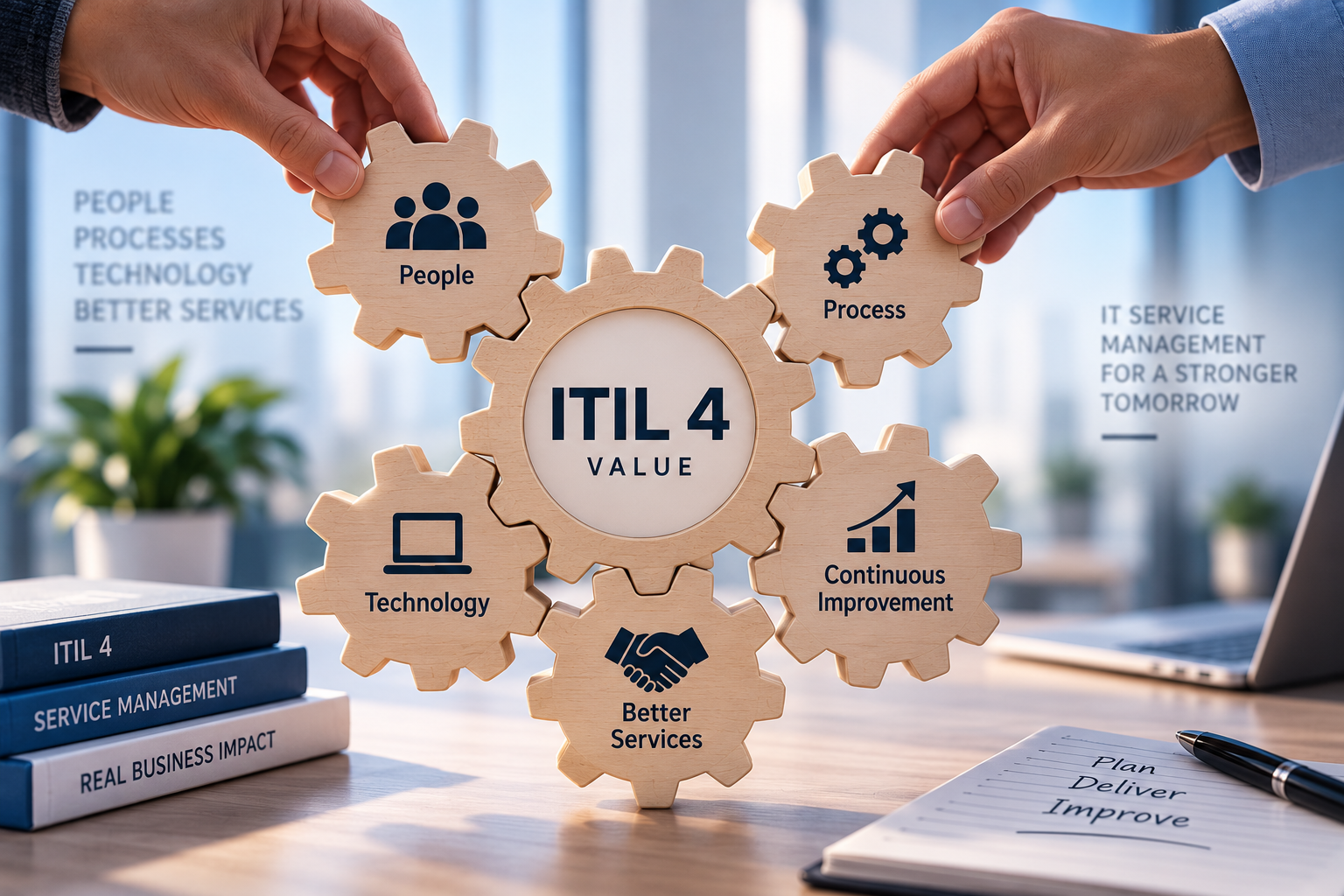
ITIL stands for Information Technology Infrastructure Library. However, modern ITIL is not simply a set of technical rules. It is a service management framework that helps organisations understand how technology, people, processes, and business goals work together.
For example, a company may successfully install a new cloud application. From a technical point of view, the project might look complete. But if employees struggle to use the application, support tickets increase, and the business does not see any real benefit, the project has not really delivered the expected value.
ITIL encourages IT teams to think beyond whether a system works. It asks whether the service is useful, reliable, well managed, and helping the organisation achieve its goals.
Why IT Teams Need More Than Technical Skills
Technical skills are still essential in IT. A cloud engineer needs to understand cloud infrastructure, a cybersecurity professional needs to understand security, and a network engineer needs to understand networking.
However, technical knowledge alone is often not enough. Modern IT professionals also need to understand how their work affects users, departments, customers, and business operations.
For example, fixing a server problem is important, but understanding why that server matters to the business is also important. If the server supports a customer-facing application, the issue may affect revenue and customer experience. If it supports an internal finance system, it may delay important business processes.
ITIL helps professionals connect technical actions with wider business outcomes. This is especially useful for people who want to move from hands-on technical roles into service management, team leadership, or IT operations.
Incident Management Still Matters
Every organisation experiences IT problems. Employees lose access to systems, applications become slow, websites stop responding, and cloud services sometimes fail.
When something goes wrong, the first priority is usually to restore normal service as quickly as possible. This is where incident management becomes important.
A clear incident management process helps teams identify what happened, understand how serious the issue is, assign responsibility, and work toward a solution. Without a structured process, teams can waste valuable time trying to decide who should handle the issue or what should happen next.
ITIL gives teams a shared approach to managing incidents. This is especially useful in larger organisations where several departments may need to work together during a service outage.
Incidents and Problems Are Different
One useful idea in ITIL is the difference between an incident and a problem.
An incident is something that interrupts or reduces the quality of a service. A problem is the underlying cause of one or more incidents.
For example, if employees keep losing access to the same application, restoring their access each time solves the incident. However, finding out why the application keeps failing and fixing the root cause is problem management.
This distinction matters because organisations can easily get stuck solving the same incidents again and again. Problem management encourages teams to look for patterns, identify root causes, and reduce the chance of the issue happening again.
Change Needs to Be Managed Carefully
Technology changes constantly. Companies update applications, modify cloud environments, introduce new tools, change security settings, and move systems between platforms.
Every change carries some level of risk. Even a small configuration update can create a major issue if it affects a critical service.
At the same time, organisations cannot make change management too slow or complicated. If every small update requires long approval processes, teams may struggle to innovate or respond quickly.
ITIL helps organisations find a balance between control and speed. The goal is not to stop change. The goal is to make sure changes are assessed, planned, and carried out in a way that reduces unnecessary risk.
This is particularly important in modern DevOps and cloud environments where teams may release changes much more frequently than in traditional IT environments.
ITIL 4 Works With Agile and DevOps
Some people still think ITIL belongs to an older style of IT management. However, ITIL 4 was designed to work with modern methods such as Agile, Lean, and DevOps.
These approaches can work together rather than compete with each other.
Agile can help teams respond quickly to changing requirements. DevOps can improve collaboration between development and operations teams. ITIL can provide a broader service management view that helps organisations understand how those activities create value for users and the business.
The goal is not to force every organisation into exactly the same process. Instead, ITIL helps teams use useful practices in a way that fits their own environment.
AI Is Changing Service Management
AI is also changing the way IT services are managed. Support teams can now use AI to help sort tickets, suggest possible solutions, identify common issues, and automate simple requests.
For example, AI may help identify whether a support request is related to password access, software, hardware, or security. It may also suggest a likely solution based on previous incidents.
However, AI does not remove the need for good service management. In many ways, it makes it even more important.
Organisations still need to decide which tasks should be automated, when human support should be involved, how service quality should be measured, and whether automation is actually helping users.
Technology can make a process faster, but it cannot automatically make a poor process better.
ITIL Creates a Common Language
Large IT departments often include professionals with very different backgrounds. Developers focus on software. Security teams focus on risk. Support teams focus on incidents. Infrastructure teams focus on systems. Business leaders focus on cost, performance, and customer experience.
When these groups use different language and different processes, collaboration can become difficult.
ITIL provides shared concepts that can make communication easier. Terms such as incident, problem, service request, change, and continual improvement give teams a common way to describe what is happening.
This is especially useful in large organisations where technology services involve several teams and departments.
Continual Improvement Is Important
One of the strongest ideas in ITIL 4 is continual improvement.
Organisations do not need to wait for a major transformation project before improving how they work. Small improvements can make a big difference over time.
For example, a team may notice that support tickets are taking too long to resolve. Another team may discover that users keep reporting the same issue. A business may find that an approval process is slowing down simple technology changes.
Instead of accepting these problems as normal, teams can review the process and look for ways to improve it.
Continual improvement encourages organisations to regularly ask where they are now, where they want to be, what is getting in the way, and what should be improved next.
Who Should Learn ITIL 4?
ITIL is useful for more than just IT service managers.
It can help service desk staff, support professionals, infrastructure teams, cloud specialists, project managers, operations teams, and people moving into leadership roles.
It is especially valuable for professionals who already have technical knowledge but want to better understand how IT services are managed across an organisation.
For beginners, ITIL 4 Foundation is usually the best starting point because it introduces the main concepts, principles, and terminology before moving into more advanced areas.
CourseMonster offers ITIL training for professionals and organisations looking to build practical IT service management knowledge and prepare for recognised ITIL qualifications.
Technical Skills and Service Skills Work Better Together
Strong technical skills are valuable, but service management knowledge can make those skills even more useful.
For example, an Azure administrator may know how to configure cloud resources. If that same person also understands change management, incident management, service impact, and business requirements, they can make better decisions when working in a live business environment.
The same applies to cybersecurity, AI, infrastructure, and support roles.
Technology does not exist on its own. It supports people, processes, customers, and business goals. Professionals who understand both the technical side and the service side can often contribute more effectively to their organisation.
Moving Forward
ITIL 4 is not about creating unnecessary paperwork or slowing IT teams down. When used correctly, it helps organisations manage technology services in a more organised, consistent, and practical way.
As businesses continue to adopt cloud technology, AI, automation, and new digital tools, IT environments are likely to become more complex. That means service management will remain important.
For IT professionals, learning ITIL can help build a stronger understanding of how modern IT organisations operate. Whether you work in support, infrastructure, cybersecurity, cloud, or management, understanding the service behind the technology can help you make better decisions and grow your career.
Explore ITIL 4 Foundation training with CourseMonster.
FAQs
Is ITIL 4 still relevant in 2026?
Yes. Organisations still need structured ways to manage incidents, problems, changes, services, and continual improvement, even as they adopt cloud technology and AI.
Is ITIL only for IT managers?
No. ITIL can be useful for support professionals, service desk teams, infrastructure staff, cloud professionals, project managers, and people working toward leadership roles.
Is ITIL 4 technical?
ITIL focuses more on managing IT services than configuring specific technologies. It works alongside technical skills rather than replacing them.
Can ITIL work with Agile and DevOps?
Yes. ITIL 4 was designed to work with modern practices such as Agile, Lean, and DevOps.
Where should beginners start?
ITIL 4 Foundation is usually the best starting point for professionals who are new to IT service management.


Comments ()