
ITIL 4 vs ITIL 5: What Changed and Which Foundation Path Is Right for You?
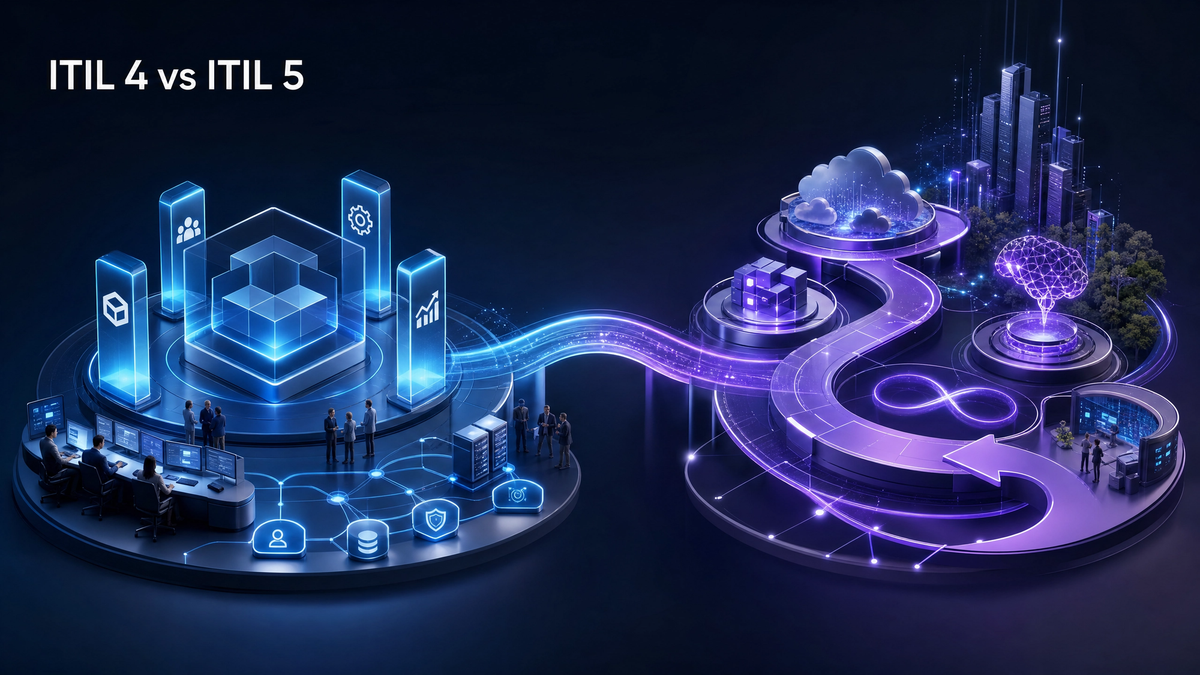
If you are researching ITIL 4 vs ITIL 5, the most important point is that the decision should not be based on the version number alone. Your best route depends on whether you are new to ITIL, already hold ITIL 4 Foundation, work in an organisation that still uses ITIL 4 terminology, or need a specialist capability rather than introductory knowledge.PeopleCert currently presents ITIL Foundation (Version 5) as an entry point into digital product and service management. Its outline focuses on the ITIL Value System, guiding principles, product and service lifecycle management, management practices, continual improvement, and value stream mapping and management. PeopleCert’s ITIL 4 Foundation page, by comparison, describes service-management concepts, the Service Value System, the four dimensions of service management, the Service Value Chain, ITIL practices, continual improvement, service-level agreements, and metrics.For a new learner, Version 5 is the current Foundation route shown by PeopleCert. For an existing ITIL 4 Foundation holder, PeopleCert also describes an ITIL Foundation Bridge (Version 5) covering the key changes at Foundation level. However, certification rules, course schedules, exam arrangements, and transition options can change. Confirm the current route before enrolling.Short answer: ITIL 4 is centred on modern service management through the Service Value System, four dimensions, the Service Value Chain, guiding principles, practices, and continual improvement. ITIL 5 places a more explicit emphasis on digital product and service management across the lifecycle, value stream mapping and management, and value creation in AI-enabled environments. The right choice depends on your qualification, role, organisation, and current PeopleCert pathway.
What is ITIL?
ITIL is a body of guidance and training used to help organisations manage digital products, services, and the activities that create value for customers and stakeholders. It is commonly associated with IT service management, but the practical questions it raises are broader than the service desk: how should work flow through an organisation, how should service quality be defined, how should teams improve, and how should technology support business outcomes?ITIL training is not the same as a guarantee of a particular job, salary, or operational result. A certification demonstrates completion of a defined learning and assessment route; capability comes from applying the ideas to real services, products, teams, suppliers, and users.CourseMonster’s ITIL training category currently includes Foundation, specialist, exam, and practical-application options. The category page also presents live virtual, classroom, and team delivery language, which makes it relevant to both individual learners and organisations planning a coordinated programme.
ITIL 4 vs ITIL 5 at a glance
The safest way to compare ITIL 4 and ITIL 5 is to start with the concepts that the official Foundation pages explicitly describe, rather than assume that every advanced module has a direct replacement.
Comparison area | ITIL 4 Foundation | ITIL Foundation Version 5 |
Primary framing | IT service management and service value | Digital product and service management |
Core architecture described by PeopleCert | Service Value System, Service Value Chain, four dimensions, guiding principles, and practices | ITIL Value System, guiding principles, lifecycle management, practices, continual improvement, and value stream mapping and management |
Lifecycle emphasis | Creating, delivering, and managing services through the Service Value Chain | Product and service lifecycle activities from discovery and design through operation, delivery, and support |
Improvement | Continuous improvement is a central concept | Continual improvement is an explicit learning area |
Flow and value | Service Value Chain and value co-creation | Value stream mapping and management and end-to-end value creation |
Operational measurement | Service-level agreements, metrics, and key performance indicators are included in the Foundation outline | Confirm the current syllabus and practice-level detail for the specific Version 5 course |
Entry point | ITIL 4 Foundation | ITIL Foundation Version 5 |
Transition information | Existing ITIL 4 holders should check the current transition route | PeopleCert describes a Foundation Bridge for ITIL 4 Foundation holders |
This table is a learning-oriented comparison, not a claim that one framework makes the other irrelevant. The official pages describe the versions in different terms and provide different learning emphases. They do not, by themselves, establish a complete equivalence chart for every practice, designation, examination, or advanced module.
The main conceptual difference: services, products, and value
ITIL 4: a service-management operating model
ITIL 4 Foundation introduces the Service Value System and explains how its elements work together to create value. PeopleCert’s current ITIL 4 outline includes the Service Value Chain, the four dimensions of service management, guiding principles, ITIL practices, service-level agreements, and performance indicators.That makes ITIL 4 useful for learners who need a common language for service management. A service desk manager may use it to think about incident, problem, change, and service-level practices. A service owner may use it to connect user needs, suppliers, technology, and operational performance. A manager may use it to create a continual-improvement rhythm rather than treat process design as a one-time project.The four dimensions also encourage a broad view of service management. People and organisations matter, as do information and technology, partners and suppliers, and value streams and processes. In practical terms, an ITSM process cannot be improved reliably if the organisation ignores the people who perform it, the tools and data they use, or the suppliers on which the service depends.
ITIL 5: a more explicit product-and-service lifecycle lens
PeopleCert’s current Version 5 page describes the certification as a foundation in digital product and service management. The learning outline covers lifecycle activities from discovery and design through operation, delivery, and support, alongside the ITIL Value System, practices, continual improvement, and value stream mapping and management.This language reflects an environment in which many organisations manage products and services together. A digital banking platform, a customer portal, a cloud platform, and the support services around them may be operated by different teams, but the user experiences them as one connected outcome. A product-and-service lifecycle lens encourages teams to consider value from the initial idea through design, delivery, operation, improvement, and eventual change or retirement.Version 5 also places value stream mapping and management within the Foundation learning areas. That is useful for organisations trying to understand how work moves across functions. Instead of looking only at an individual queue or team, a value-stream view asks where work waits, where decisions are repeated, where handoffs create risk, and how an idea becomes a usable product or service for the customer.The practical implication is not that every ITIL 4 practice must be discarded. Rather, learners should understand the current Version 5 syllabus and consider how its language may help them connect service-management work to digital-product outcomes.
What remains important in both versions?
When comparing ITIL 4 vs ITIL 5, it is easy to focus on labels and miss the capabilities that remain important in day-to-day work. Regardless of the version or course route, effective service management requires people who can understand demand, define outcomes, manage risk, collaborate across teams, improve flow, and learn from performance data.
Value creation
IT teams should be able to explain how a service or product creates value for users and the organisation. A technical activity is not automatically valuable because it is sophisticated. Its value depends on whether it improves an outcome, reduces risk, enables a capability, or supports a meaningful user need.
Guiding principles
Both PeopleCert Foundation outlines include guiding principles as an important learning area. The principles are useful because they help teams make decisions when a process is incomplete or a situation does not fit a textbook example. They encourage teams to focus on value, begin where they are, progress iteratively, collaborate, think holistically, keep work practical, and optimise or automate where appropriate.
Continual improvement
Improvement should be treated as a managed capability. Teams need a way to identify opportunities, prioritise them, test changes, measure results, and decide whether to continue, adapt, or stop. A new certification does not create continual improvement by itself; leadership, measurement, time, and feedback are required.
Practices applied to context
Frameworks provide structure, but organisations still need to tailor their approach to their size, risk profile, technology, regulatory environment, suppliers, and users. A small product team and a global public-sector service may use the same concepts differently. The course route should therefore be chosen alongside an application plan.
ITIL 4 Foundation vs ITIL Foundation Version 5
Who should consider Version 5 Foundation?
Version 5 Foundation is a logical route to investigate if you are new to ITIL, moving into IT service management, or working with digital products and services and want the current Foundation terminology. PeopleCert positions it as suitable for any career stage and as an entry point into ITIL.You may be a service desk analyst who wants to understand how support connects to the wider lifecycle. You may be a product or platform professional who needs a structured language for value, lifecycle management, and continual improvement. You may also be a manager who wants enough context to participate in ITSM and digital-product decisions without becoming a specialist in every practice.Before booking, review the actual course page, delivery format, exam arrangement, prerequisites, and date. CourseMonster’s ITIL course category is the appropriate place to compare current options and enquire about availability.
Who should consider ITIL 4 Foundation?
ITIL 4 Foundation may still be relevant when an employer, customer, transformation programme, or existing service-management environment uses ITIL 4 terminology and practices. It may also be relevant when a learner needs the ITIL 4 Foundation course or exam specified by an existing role requirement.That does not mean that ITIL 4 is automatically the better choice for every experienced professional. It means the decision should be tied to the environment in which the knowledge will be used. If your team’s operating model, documentation, supplier requirements, or internal development path is built around ITIL 4, a course aligned to that environment may be easier to apply immediately.Check the current PeopleCert ITIL 4 information and the receiving organisation’s expectations before choosing. The official ITIL 4 Foundation page describes the Service Value System, four dimensions, Service Value Chain, practices, continual improvement, SLAs, and metrics as part of the learning scope.
Who should consider the ITIL Foundation Bridge?
PeopleCert describes the ITIL Foundation Bridge (Version 5) as a route for ITIL 4 Foundation holders to learn the key changes at Foundation level and achieve the Version 5 certification through a shorter transition module and exam.The Bridge is most relevant to people who already hold the underlying ITIL 4 Foundation qualification and want to understand the Version 5 Foundation differences. It should not be treated as a universal substitute for every advanced course. Confirm the following points before enrolling:
Question | Why it matters |
Do you hold the required ITIL 4 Foundation qualification? | Bridge eligibility is not the same as simply having attended an ITSM course. |
Is the Bridge available in your region and preferred format? | Course schedules and delivery options can vary. |
What examination is included? | Confirm whether the course, exam, voucher, and retake terms are bundled. |
Do you need Foundation knowledge or advanced practice capability? | A Bridge may not address the depth required for specialist work. |
Does your employer require a specific version? | Internal role frameworks may not update at the same time as the vendor portfolio. |
What about ITIL 5 specialist courses?
A common mistake in the ITIL 4 vs ITIL 5 discussion is to assume that the existence of a new Foundation route automatically answers every question about specialist and leadership-level progression. It does not.If you need a specialist capability, start with the work you need to perform. Do you need to improve high-velocity service delivery, create and support services, manage stakeholder value, plan and improve, or apply change and release practices? Then compare the current PeopleCert pathway with the courses listed by CourseMonster.CourseMonster’s current ITIL category displays a mixture of Version 5 Foundation, ITIL 4 specialist, high-velocity, stakeholder-value, strategist, exam, and practical-application options. That mix makes it particularly important to check the exact course title, syllabus, prerequisites, examination status, and transition guidance at the time of enrolment.For organisations, the right solution may be a role-based sequence rather than a single version decision. A new service-desk cohort may need Foundation training. Service owners may need practice-level application. Leaders may need governance, measurement, and continual-improvement capability. A team programme should connect those levels rather than assume every person needs the same certification.
How to choose between ITIL 4 and ITIL 5: a decision framework
Use the following sequence to make the decision more confidently.
1. Identify your current qualification
Write down whether you hold ITIL 4 Foundation, an older ITIL qualification, another service-management credential, or no formal qualification. Do not infer Bridge eligibility from job experience alone; confirm the vendor’s current requirements.
2. Identify the environment in which you will apply the learning
Ask which terminology your organisation uses in policies, job descriptions, supplier contracts, service reviews, and improvement boards. If the environment is in transition, ask whether the employer wants a Version 5 qualification, ITIL 4 capability, or simply practical ITSM knowledge.
3. Define the outcome
A Foundation course can create shared understanding. It does not replace a role-specific operating model. Define what success means: better service reviews, clearer ownership, improved change coordination, stronger lifecycle visibility, more consistent measurement, or a common language across teams.
4. Check the exact syllabus and exam route
Titles and course pages can change. Confirm what is included, whether an exam is available, how the exam is scheduled, what prerequisites apply, and how the qualification is maintained. PeopleCert’s current Version 5 page states a 40-question, 60-minute exam with a 65% pass mark and describes a three-year renewal route involving PeopleCert Membership and 60 CPD points. Treat those details as time-sensitive and verify them again before booking.
5. Choose the delivery model
Individual learners may prefer a live virtual or self-paced route. Teams may benefit from classroom or onsite training where content can be discussed in the organisation’s context. CourseMonster states that it supports live virtual, classroom, and team options where available, and its onsite-training guidance is aimed at groups of three or more.For ongoing development across multiple technology and management areas, compare a training subscription. For larger programmes involving multiple vendors, roles, locations, and schedules, consider whether vendor managed learning could reduce administrative complexity.
How organisations should manage the transition
A version change is not only a training decision. It can affect role profiles, process documentation, measurement, supplier language, internal communities of practice, and the way teams discuss value and improvement.
Audit the current state
Create a simple inventory of current qualifications, active ITSM processes, service-management roles, key suppliers, major products, and current terminology. Include teams that support digital products even if they do not use the job title “ITSM”.
Segment learners by role
Do not enrol every employee on the same course by default. Group learners according to the decisions they make and the work they perform. A service desk group, product team, service owner, change authority, supplier manager, and executive sponsor may need different depths of learning.
Create a common glossary
If the organisation uses ITIL 4 and Version 5 terminology during a transition period, document the terms that matter for daily work. The aim is not to create a perfect dictionary of every concept. The aim is to prevent misunderstandings in incident reviews, service reports, improvement backlogs, and governance meetings.
Pilot an application scenario
After training, choose one service, product, or value stream and apply the concepts to it. Map the work, identify waiting points, review ownership, examine measures, and select one improvement. This turns certification knowledge into a visible operating experiment.
Measure application, not only attendance
Track completion and assessment, but also examine whether teams can explain value, identify service risks, improve handoffs, use metrics, and run better reviews. A training programme that produces certificates without changed behaviour needs a better application plan.
ITIL training formats for individuals and teams
The best delivery format depends on the audience, schedule, location, level of customisation, and number of learners.
Format | Often suitable for | What to verify |
Live virtual class | Distributed learners who need instructor interaction | Time zone, class schedule, interaction, exam arrangements, and technical requirements |
Classroom course | Learners who benefit from a fixed cohort and in-person discussion | Location, dates, travel, accessibility, and class size |
Onsite team training | Three or more learners with a shared business context | Customisation, minimum cohort size, course scope, and delivery location |
Self-paced learning | Learners who need flexibility around work or time zones | Content access period, instructor support, exam inclusion, and assessment |
Training subscription | Organisations with recurring demand across eligible catalogues | Eligible courses, seats, expiry, reporting, delivery format, and exam terms |
Managed learning | Enterprises coordinating multiple vendors, teams, and locations | Service scope, governance, reporting, procurement, and success measures |
Explore CourseMonster’s ITIL training courses to compare available routes. If you are planning a group programme, ask about onsite training and how the content can be aligned to your service environment.
Frequently asked questions about ITIL 4 vs ITIL 5
Is ITIL 5 replacing ITIL 4?
The safest answer is that PeopleCert currently presents ITIL Foundation Version 5 as an available Foundation route while also maintaining an ITIL 4 Foundation page and related ITIL 4 options in its portfolio. CourseMonster’s current category page also lists both Version 5 Foundation and ITIL 4 specialist or practical options. Do not assume that every ITIL 4 course, designation, or qualification has an immediate Version 5 replacement. Check the current official pathway.
Should I take ITIL 5 Foundation if I already have ITIL 4 Foundation?
Not automatically. Review the Foundation Bridge described by PeopleCert, then compare eligibility, timing, employer expectations, delivery, exam arrangements, and your future learning goals. If your organisation still uses ITIL 4 extensively, you may also need to apply the knowledge you already have before adding a new qualification.
Is the ITIL Foundation Bridge the same as retaking Foundation?
PeopleCert describes the Bridge as a module covering the key changes introduced at Foundation level for ITIL 4 Foundation holders. It is therefore a transition route, not simply a duplicate full Foundation course. Confirm the current syllabus, exam, eligibility, and availability before enrolment.
Which ITIL version is better for beginners?
For someone with no ITIL qualification, compare the current Version 5 Foundation route with the role and environment in which the knowledge will be used. PeopleCert positions Version 5 Foundation as an entry point, but the correct course still depends on availability, employer requirements, and the learner’s objective.
Can I use ITIL 4 knowledge in a Version 5 environment?
Existing ITIL 4 knowledge can remain useful because both routes address service management, value, principles, practices, and improvement. However, do not assume that terminology, practice guidance, exams, or advanced progression are identical. Use the current Version 5 syllabus and the organisation’s operating model to identify what needs to be learned or updated.
Does ITIL certification guarantee career advancement?
No certification can guarantee a job, promotion, salary, or project outcome. ITIL training can provide a recognised learning route and a structured language for service management, but career value depends on experience, role fit, performance, market conditions, and how the knowledge is applied.
How often should I review ITIL certification information?
Review it before enrolment, before booking an exam, and whenever PeopleCert announces a new product, renewal, or transition policy. CourseMonster course availability and schedules should also be confirmed at the time of enquiry.
Final verdict: how to choose the right ITIL path
The ITIL 4 vs ITIL 5 decision is best treated as a fit-and-timing decision, not a simple contest between old and new. ITIL 4 Foundation provides a structured introduction to service-management concepts, the Service Value System, four dimensions, the Service Value Chain, practices, continual improvement, SLAs, and metrics. ITIL Foundation Version 5 places more explicit emphasis on digital product and service management, lifecycle thinking, value stream mapping and management, the ITIL Value System, and continual improvement.If you are new to ITIL, investigate Version 5 Foundation and compare it with your intended role and employer environment. If you hold ITIL 4 Foundation, examine the Bridge route and verify eligibility. If you need advanced capability, compare the specific practice or leadership course rather than choosing a version based only on the headline.For individuals, start by reviewing the ITIL training options at CourseMonster. For teams, discuss whether onsite training, live virtual delivery, or a broader managed learning programme would better connect training to operational outcomes.
Publication and policy note
This article is educational content, not certification, legal, or career advice. PeopleCert examination rules, renewal arrangements, transition modules, course titles, and regional availability may change. Verify current details with PeopleCert and CourseMonster before making an enrolment or organisational training decision.
Comments ()